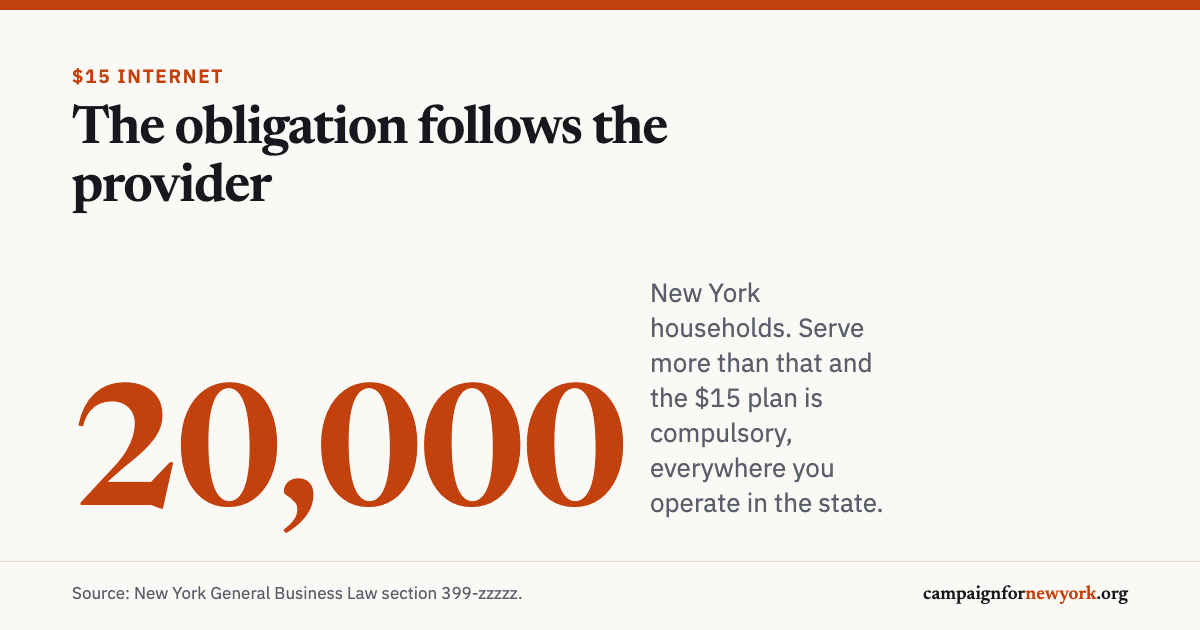
The obligation follows the provider, not the postcode. Any internet company serving more than 20,000 households in New York must sell a qualifying household 25 Mbps for $15 a month, or 200 Mbps for $20, everywhere it operates in the state. So the real question is not where you live. It is who serves you.
Which providers have to offer the $15 plan?
Any provider above the 20,000-household line in New York, and that captures every large operator in the state. New York General Business Law § 399-zzzzz sets the threshold in households served rather than in geography, which is what makes this law unusually easy to apply. Charter, trading as Spectrum, is far past it. So are Altice, trading as Optimum, and Verizon.
Once a provider crosses that line it must comply across its whole New York footprint. There is no rural carve-out for a big company and no city-only version of the entitlement. If Spectrum serves your street in Chautauqua County, the same obligation applies as in Manhattan.
The exemption route exists for the other end of the market. A provider at or under 20,000 households may seek an exemption where complying would cause an unreasonable or unsustainable financial impact, and the Public Service Commission has reinstated temporary exemptions for that group.
How do you find out who serves your address?
New York State runs the lookup itself, which is the fastest honest answer available. mapmybroadband.dps.ny.gov takes an address and returns the providers on record for it. Do that before you ring anybody, because the conversation goes differently when you already know which company is obliged to you and which is merely selling to you.
In New York City you can also dial 311 and ask for low-cost internet. Everywhere else in the state, dial 211.
What the map will not tell you is whether a small provider has an exemption. If the only company serving your address is a local telephone company, ask them directly. They are allowed to be exempt, it is not an evasion, and knowing is better than arguing.
Which counties are genuinely thin on providers?
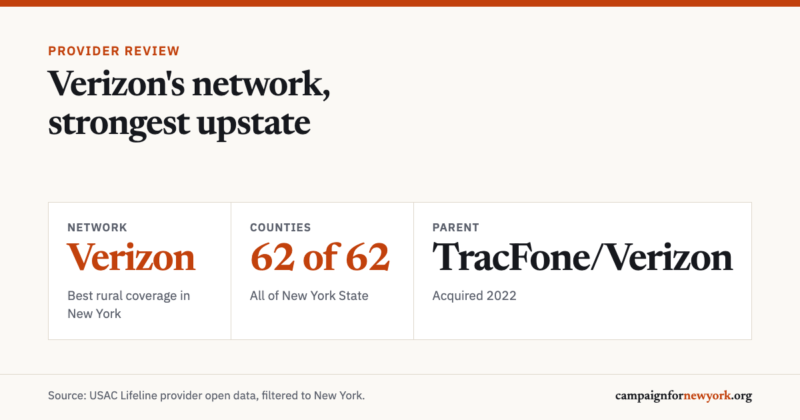
The top of the state and the rural west, where wireline service often comes from a company most New Yorkers have never heard of. USAC’s provider data makes the shape of it visible. On the wireline side, Verizon and Integrated Path Communications appear across all sixty-two counties and Frontier across fifty-two. After that it drops away quickly: Xchange Telecom in sixteen counties, Windstream in fifteen, and then a long tail of village telephone companies — Chazy Westport, Champlain Telephone, Delhi Telephone, Margaretville Telephone — each serving a handful of ZIP codes.
Several of those sit below the 20,000-household line and can seek an exemption. That is where a rural household may genuinely find the answer is no.
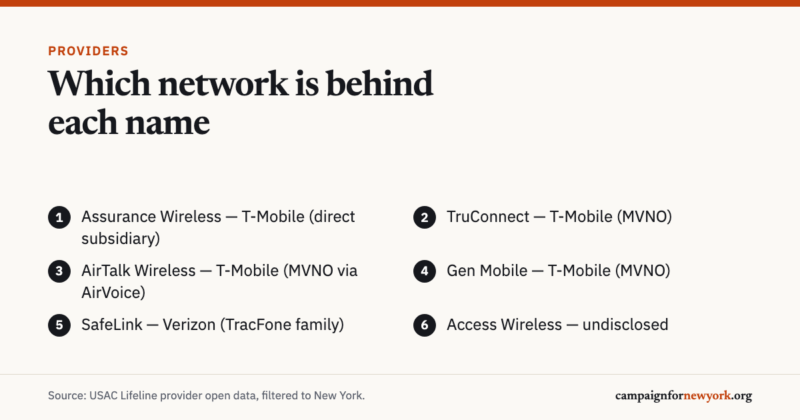
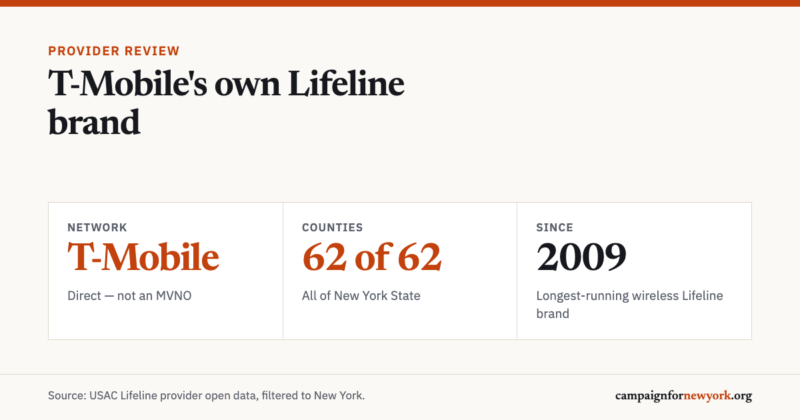
Mobile is the opposite picture. Six Lifeline mobile providers cover all sixty-two counties, so no county in New York is without at least one option on the phone side.
Does the county you live in change your rights?
Not directly, and that is the point worth holding on to. The statute grants the entitlement against providers, so two households in different counties served by the same company have identical rights. What county changes is the menu — how many companies serve you, whether one of them is small enough to be exempt, and whether fibre is among them.
Two of the six qualifying routes do vary by geography, though for a different reason. SCRIE and DRIE are New York City rent exemption programmes, so those two routes exist only inside the five boroughs. The other four — school lunch, SNAP, Medicaid and a utility affordability benefit such as HEAP — apply statewide.
So a household in Erie County has fewer ways in than one in Brooklyn, not because the law is weaker upstate but because two of the qualifying programmes are municipal.
What are the three big providers actually selling?
New York City’s Office of Technology and Innovation publishes the current plans, which is a better source than any provider’s own page. Verizon Forward gives 300 Mbps at $15 with autopay, Optimum Advantage Internet 50 Mbps at $14.99, and Spectrum Internet Assist 50 Mbps at $15:
| Provider | Plan | Speed | Price |
|---|---|---|---|
| Verizon | Verizon Forward | 300 Mbps | $15 with autopay |
| Optimum | Optimum Advantage Internet | 50 Mbps | $14.99 |
| Spectrum | Spectrum Internet Assist | 50 Mbps | $15 |
| Optimum | Optimum Advantage Plus | 100 Mbps | $25 |
Verizon Forward is the outlier and the best deal in the table, giving 300 Mbps at the Tier 1 price. If Fios reaches your building, start there.
Optimum Advantage Plus is worth a second look for the opposite reason. At 100 Mbps for $25 it is slower than the statutory Tier 2 and five dollars dearer, so if that is what you are offered, ask what they are selling that meets 200 Mbps at $20.
What if your provider says the plan does not exist?
Assume the person answering has never been trained on it, because that is usually true. Providers sell branded products with their own eligibility lists — Spectrum Internet Assist, Optimum Advantage, Verizon Forward — and those lists can be narrower than the statute. Internet Assist, for instance, names only school lunch, its Community Eligibility Provision, and SSI, while § 399-zzzzz names SNAP and Medicaid too. That gap is the single commonest reason a qualifying household is turned away, and it is covered in detail in what to do when Spectrum refuses you on SNAP.
Ask whether you were assessed against the branded programme or against the Affordable Broadband Act. Then say the words, name your qualifying programme, and ask to escalate.
If it still fails, the Department of Public Service takes consumer complaints directly, the matter sits under case 24-00933, and non-compliance carries civil penalties of up to $1,000 per violation.
Why did a 2021 law only start mattering recently?
Because the industry sued, and for a while it won. New York passed the Affordable Broadband Act in 2021. Trade groups representing the large providers challenged it immediately, arguing that federal law pre-empted a state from setting broadband prices, and a district court blocked it before it applied to anybody. That block held for roughly three years.
It was overturned on appeal, and the case ended when the Supreme Court declined to take it further in December 2024. Only then did the obligation become real.
Two consequences still shape what happens on the phone. Staff have had far less time to learn the law than they have had to learn their own products. And a household that looked into this before the case ended, was told the law was blocked, and gave up, was told something that was true then and is not true now.
What is it worth, once you have found the right company?
The cap is on the whole bill rather than the headline rate, which is where most of the value sits. Recurring taxes, equipment rental and usage fees all have to sit inside the price. No modem rental afterwards, no overage. What is not covered is one-off money, so ask what the first bill will be rather than what the monthly price is.
Then stack it. The $15 comes from state law and the federal Lifeline discount of $9.25 comes from somewhere else entirely, so applying Lifeline to an Affordable Broadband Act plan brings the bill to $5.75 a month. One Lifeline benefit per household, on one service.
The entitlement in full is in the Affordable Broadband Act guide, the provider-by-provider view is in the plan comparison, and nothing on this site is paid for by any company named on this page, as set out in the disclosure.