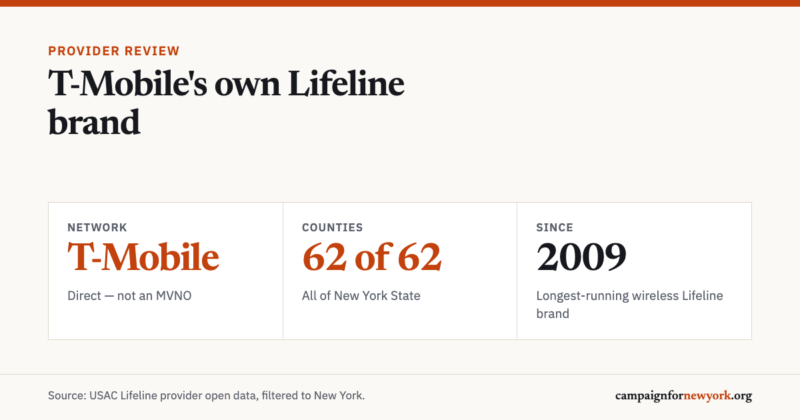
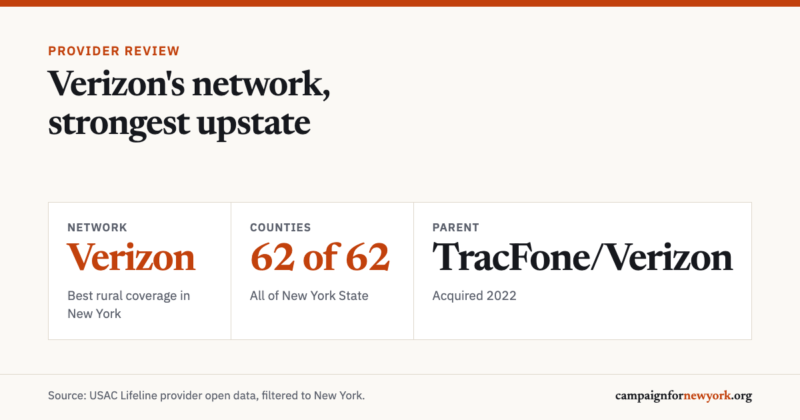
Five of the six verified wireless Lifeline providers in New York run on T-Mobile’s network. One runs on Verizon’s. USAC data confirms these six carriers hold active designations in the state, but the network each uses is never disclosed on your Lifeline application or approval letter. The distinction matters because your network determines your coverage, your speed during congestion, and your options if service fails.
Which network does each Lifeline provider use in New York?
Four providers use T-Mobile, one uses Verizon, and one does not publicly disclose its network partner. The table below maps every verified wireless Lifeline carrier in New York State to its underlying network, based on FCC filings, corporate disclosures, and USAC’s open data reviewed when I last checked.
| Provider | Network | Relationship | NYC Coverage | Upstate Coverage |
|---|---|---|---|---|
| Assurance Wireless | T-Mobile | Direct subsidiary | Strong | Moderate — gaps in Adirondacks, Southern Tier |
| TruConnect | T-Mobile | MVNO | Strong | Moderate — same T-Mobile gaps |
| AirTalk Wireless | T-Mobile | MVNO (via AirVoice) | Strong | Moderate — same T-Mobile gaps |
| Gen Mobile | T-Mobile | MVNO | Strong | Moderate — same T-Mobile gaps |
| SafeLink Wireless | Verizon | Subsidiary (via TracFone) | Strong | Strong — best rural reach |
| Access Wireless | Undisclosed (likely T-Mobile) | MVNO | Likely strong | Likely moderate |
Sources: USAC Lifeline programme data, FCC ETC designations, and each provider’s public filings. See how we research for methodology.
What is an MVNO and why does it matter for Lifeline?
An MVNO — Mobile Virtual Network Operator — is a company that buys wholesale access to another carrier’s towers and resells it under its own brand. The MVNO does not own spectrum or infrastructure. It rents capacity from a host network under contract terms that define speed, priority, and data limits.
For Lifeline subscribers, this distinction affects one thing above all else: what happens when the network is congested. A direct subsidiary like Assurance Wireless shares T-Mobile’s own priority tier. An MVNO like TruConnect or AirTalk may be deprioritized — meaning T-Mobile’s own customers and subsidiaries get bandwidth first, and MVNO traffic is served with whatever remains.
In practice, deprioritization is noticeable in specific high-density situations: Times Square during events, transit hubs at rush hour, stadiums, dense apartment buildings with many devices on one tower. In normal daily use across most of New York, the difference between a direct subsidiary and an MVNO on the same network is negligible.
What is the difference between a subsidiary and an MVNO?
A subsidiary is owned by the parent carrier. An MVNO is an independent company buying access. The distinction is corporate, but it has real service implications for priority, support routing, and long-term stability.
Assurance Wireless is T-Mobile’s direct subsidiary — a brand T-Mobile operates itself for Lifeline. T-Mobile files Assurance’s ETC designations, funds its operations, and treats its subscribers as its own customers on the network. According to T-Mobile’s corporate page, Assurance is part of T-Mobile’s business portfolio.
SafeLink Wireless is TracFone’s Lifeline brand, and TracFone has been a Verizon subsidiary since the 2021 acquisition. SafeLink runs on Verizon’s network with the priority treatment that comes from being an owned brand rather than a wholesale customer.
TruConnect, AirTalk, and Gen Mobile are independent companies using T-Mobile towers through MVNO agreements. They set their own plan terms, handle their own customer service, and pay T-Mobile for network access. Their subscribers may experience deprioritization during congestion that Assurance subscribers do not.
Access Wireless is operated by Quadrant Holdings. It does not publicly disclose its network partner. Based on device compatibility requirements and coverage patterns, the network is likely T-Mobile, but this is not officially confirmed.
Does network priority actually affect Lifeline service quality?
It does — but only in specific conditions. Network priority determines the order in which traffic is served when a cell tower is at capacity. Under normal load, all subscribers on the same tower get comparable speeds regardless of priority tier.
Congestion happens predictably in New York. Midtown Manhattan during business hours. Penn Station and Grand Central at rush. The subway stations with underground coverage. Large public events in any borough. If you use your phone primarily in these environments, an MVNO’s deprioritization is a factor worth weighing.
If you live and work in areas with normal tower load — most residential neighbourhoods, most suburban locations, most upstate cities — the priority difference between Assurance and TruConnect will not be perceptible in daily use. Both deliver the same T-Mobile signal from the same towers at speeds governed more by signal strength than by priority class.
Which network has better coverage in upstate New York?
Verizon has stronger rural coverage in upstate New York than T-Mobile. This makes SafeLink the better choice for subscribers who live in the Adirondacks, the Catskills interior, the North Country, or the Southern Tier along the Pennsylvania border.
T-Mobile’s coverage is strong in upstate cities — Albany, Syracuse, Rochester, Buffalo, Binghamton — and along major corridors like the Thruway. It weakens between these anchors, particularly in low-population areas where tower density drops. The T-Mobile coverage map and the Verizon coverage map are worth checking for your specific address before committing.
A USAC designation covering a county means the provider is authorised to serve that county. It does not mean signal reaches every address within it. Assurance, TruConnect, AirTalk, and Gen Mobile all show broad county coverage in USAC data — but all four depend on T-Mobile towers that may not reach your location in a rural area.
Which network has better coverage in New York City?
Both T-Mobile and Verizon provide strong coverage across the five boroughs. For a Lifeline subscriber in NYC, the network difference is not a reason to choose one provider over another. Choose based on plan terms, device quality, and customer service instead.
T-Mobile has invested heavily in New York City infrastructure, including subway coverage via the MTA’s underground wireless project. Verizon holds similar strength above ground and in many underground stations. Neither network has meaningful dead zones in populated areas of the city.
The practical differentiator in NYC is congestion priority, not coverage. If you spend time in the densest environments — Times Square, Herald Square, major transit hubs at peak hours — Assurance (T-Mobile direct) or SafeLink (Verizon direct) will deliver more consistent speeds than the MVNOs on the same towers.
Can you check which network your current provider uses?
Your provider is not required to disclose its network partner on marketing materials or in your service agreement. Some do. Others bury it. The most reliable methods to confirm your network are practical, not administrative.
Check your phone’s settings. On Android: Settings, About Phone, SIM Status — the network name displayed is your actual carrier connection, not your billing provider. On iPhone: Settings, General, About — look at the “Network” or “Carrier” field. If your Lifeline provider is AirTalk but your phone shows “T-Mobile” in the network field, you are on T-Mobile’s towers.
Alternatively, dial *#06# to display your IMEI, then check the device’s band compatibility. If it supports bands 2, 4, 12, 66, and 71 — those are T-Mobile’s primary bands. If it supports bands 2, 4, 5, 13, and 66 — those are Verizon’s. The bands your Lifeline device supports will tell you which network it was provisioned for.
Does switching providers change your network?
It can. Moving from TruConnect to SafeLink moves you from T-Mobile to Verizon. Moving from AirTalk to Assurance keeps you on T-Mobile but upgrades your priority from MVNO to direct subsidiary. The Lifeline transfer process lets you switch providers without re-qualifying — your eligibility carries over.
If coverage is your issue, switching from a T-Mobile MVNO to another T-Mobile MVNO solves nothing. The towers are identical. Gen Mobile, TruConnect, AirTalk, and Assurance all serve the same T-Mobile signal. Only SafeLink offers a different network in New York’s Lifeline market.
To switch, contact your new provider or use the National Verifier at checklifeline.org to update your provider selection. The old service deactivates when the new one begins. You can keep your phone number through the transfer process in most cases.
Our recommendation
The network concentration in New York’s Lifeline market is a problem for consumers. Four of six providers run on T-Mobile, giving subscribers the illusion of choice without actual network diversity. If T-Mobile’s coverage fails you, SafeLink is your only alternative — not one of four alternatives, the only one.
For NYC metro subscribers: any of the six providers will deliver adequate coverage. Choose based on plan terms and device quality. For a deeper comparison, see our full provider comparison.
For upstate and rural subscribers: start with SafeLink. If Verizon coverage is confirmed strong at your address, SafeLink is the rational choice regardless of what other providers offer in plan terms. No data allowance matters if the signal does not reach your home.
For our full review of the newest provider in this list, see the Gen Mobile review. For all provider guides, start at the category page.
Check which providers serve your ZIP at USAC’s Companies Near Me tool. Verify eligibility at checklifeline.org. This site carries no referral links — see /disclosure.