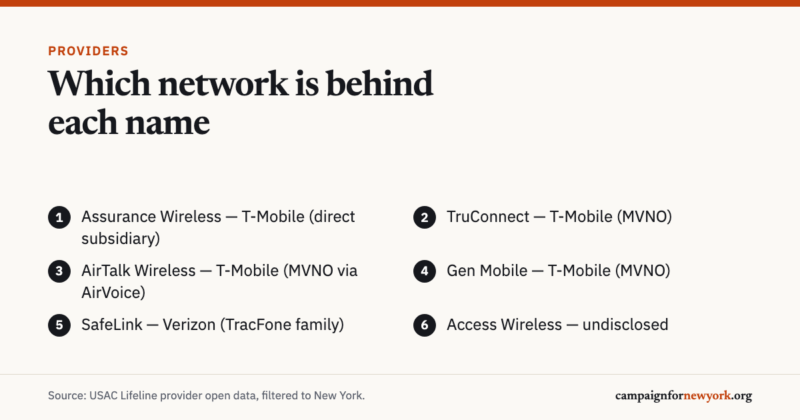
Assurance Wireless is T-Mobile’s Lifeline brand and the largest wireless Lifeline provider in the country by subscriber count. In New York, USAC data confirms it holds designations covering all sixty-two counties. It runs on T-Mobile’s own network — not as an MVNO reselling tower access, but as a direct subsidiary — which matters for both coverage quality and network priority.
What you get
| Feature | Assurance Wireless |
|---|---|
| Network | T-Mobile (direct subsidiary, not MVNO) |
| NY coverage | All 62 counties |
| Minimum voice | 1,000 minutes (often unlimited) |
| Minimum data | 4.5 GB at 3G or better |
| Free device | Entry-level Android (model varies) |
| BYOD | Yes, any T-Mobile compatible phone |
Assurance Wireless provides a free monthly plan to approved Lifeline subscribers. The federal minimum floor requires at least 1,000 voice minutes and 4.5 GB of mobile broadband at 3G speeds or better before a provider can claim the $9.25 monthly reimbursement from USAC.
Assurance has historically offered unlimited talk and text with a data allowance that varies by state and by what promotions are running at the time. The exact plan details change without notice, so check assurancewireless.com for what is currently available in your ZIP code.
What stays constant is that unlimited on a Lifeline plan typically means a high-speed allowance followed by throttling. The throttled speed is where plans actually differ — some providers throttle to 128 kbps (barely functional for messaging), others to 256 or 512 kbps. Ask how much data runs at full speed and what speed it drops to afterward. A provider who will not answer the second question with a number has told you something useful about how they expect you to use the service.
One thing Assurance does not provide: international calling. If you need to call outside the United States, you will need a separate service or a calling card. The Lifeline subsidy covers domestic service only, and Assurance does not add international minutes on top.
The device
Assurance offers a free smartphone to new subscribers. The model depends on current stock and your location. Historically, it has been an entry-level or refurbished Android handset — think Moto G, Samsung A series, or similar. iPhones have appeared in some markets during promotional periods but are not the standard offering and cannot be requested specifically.
If you already have a compatible T-Mobile-network phone, you can bring your own device instead. The $9.25 subsidy is identical either way — taking or declining the handset does not change what the plan costs or covers. Bringing your own keeps you unlocked and free to switch without losing hardware you depend on.
A practical note: if you take the free device, confirm whether it arrives locked to Assurance. A locked phone cannot move to another carrier until you complete an unlock request, which typically requires a minimum period of active service. This is legal and standard in the industry, but it ties you to a provider you have not yet tested.
Who qualifies in New York
The eligibility rules are Lifeline’s, not Assurance’s. A provider cannot add to or subtract from the qualification list. You qualify through any of these routes:
- Federal programmes: SNAP, Medicaid, Supplemental Security Income (SSI), Federal Public Housing Assistance, or Veterans and Survivors Pension Benefit
- New York State additions: HEAP (Home Energy Assistance Program), Family Assistance or Safety Net Assistance, or the National School Lunch Program
- Income: Household income at or below 135% of the Federal Poverty Guidelines
One benefit per household. A household is defined as people who live together and share income and expenses — not merely an address. Roommates who maintain separate finances are separate households, each eligible for one benefit. If another person in your household already receives Lifeline through any provider, you cannot add a second line through Assurance or anyone else.
The New York additions matter because they appear on no federal guide. HEAP alone opens Lifeline for households that receive only energy assistance and hold none of the five federal qualifying benefits. If you have a HEAP award letter from the last twelve months, you qualify here even though a national guide would tell you otherwise.
How to apply
There are two legitimate paths, and one that is not allowed:
Through the National Verifier directly. Go to checklifeline.org, apply, and once approved choose Assurance Wireless as your provider. This keeps control with you — the eligibility decision is already made, you see the full provider list, and you pick who gets your subscription without pressure.
Through Assurance’s own site. They walk you through the National Verifier application as part of their sign-up flow. The result is the same — the same database is checked, the same eligibility rules apply — but the framing puts you inside their funnel from the start. You have effectively chosen your provider before knowing whether you qualify.
Not over the phone. USAC’s instructions to providers state plainly that a provider may not accept a Lifeline application over the phone and may not initial or sign it on your behalf. If anyone offers to complete your application during a phone call, that is a reliable place to end the conversation.
Most applications clear automatically. The National Verifier queries federal and state benefit databases directly, and where it finds a match no documents need to be uploaded. Documents are only requested when the automatic check fails — typically because of an address mismatch between your application and what the benefit agency has on file.
Coverage in New York
Assurance Wireless runs on T-Mobile’s network. In New York City and the surrounding metro area — the five boroughs, Long Island, Westchester, Rockland — T-Mobile coverage is strong and has been since well before the Sprint merger brought additional spectrum. The network holds up in most suburban and exurban areas across the state, including the Hudson Valley, Capital District, and the cities of Syracuse, Rochester, and Buffalo.
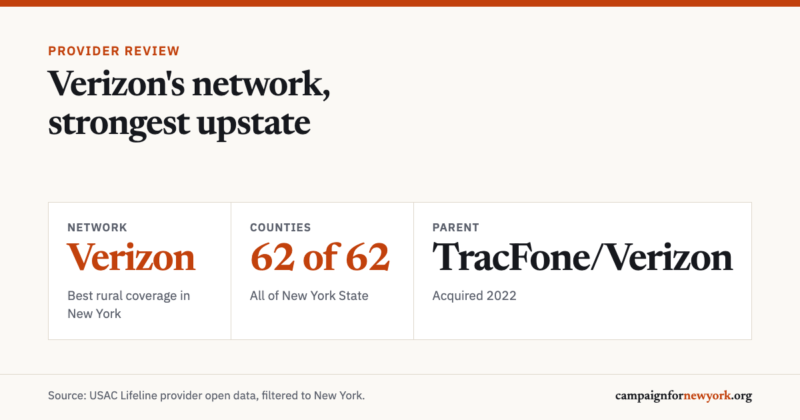
The weaker points are rural upstate stretches: the Adirondacks, the Catskills interior, and thin-population corridors along the Pennsylvania border in the Southern Tier. If you live in one of these areas, check T-Mobile’s coverage map for your specific address before committing. The USAC designation covers all sixty-two counties, but that means the provider is authorised to serve them, not that signal reaches every road within them.
One advantage of being T-Mobile’s own brand rather than an MVNO: during network congestion, Assurance subscribers are not deprioritised the way third-party resellers might be. In practice this matters at large events, transit hubs during rush hour, and dense apartment buildings — places where many devices compete for the same tower. For everyday use in normal conditions, the difference is negligible.
Pros and cons
- Pro: Largest Lifeline provider nationally — established infrastructure, consistent customer service hours, and less likely to disappear or be acquired
- Pro: T-Mobile’s own network rather than an MVNO arrangement — one fewer middleman between you and the tower, no deprioritisation
- Pro: Covers all 62 New York counties in USAC’s data
- Pro: Free device included if you need one
- Pro: Simple, standardised offering without complex promotional tiers
- Con: T-Mobile rural coverage has gaps in upstate New York, particularly the Adirondack region and Southern Tier
- Con: Plan details (exact data cap, throttle speed) change without notice and are not always clearly stated upfront
- Con: Customer service wait times can be long — this is a high-volume provider serving millions of subscribers nationally
- Con: The free handset is typically entry-level and may feel slow within a year
- Con: No international calling included
Bottom line
Assurance Wireless is the safe default. It is the largest, it runs on a major network without MVNO complications, and it covers every county in the state. That does not make it the best choice for every household — if you live in a rural area where T-Mobile is weak, SafeLink on Verizon’s network will serve you better. If you value a specific handset model, no Lifeline provider can guarantee one.
But if you want to enrol quickly, with minimal friction, and you live somewhere T-Mobile works well — which is most of the New York City metro area and the majority of suburban locations statewide — Assurance is the provider least likely to surprise you. It is boring in the way a utility should be boring, and that is the highest compliment available.
Check whether they serve your ZIP at USAC’s Companies Near Me tool before applying, and verify your eligibility at checklifeline.org. This site carries no referral links — the disclosure is at /disclosure.