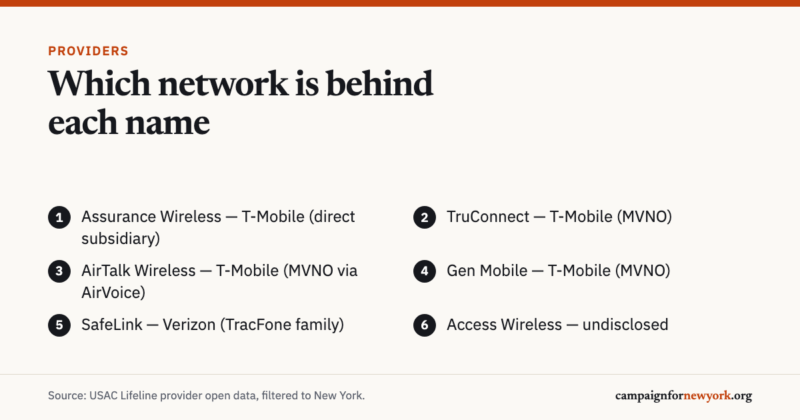
SafeLink Wireless is TracFone’s Lifeline brand, now owned by Verizon after the 2022 acquisition. In USAC’s New York data it appears alongside Straight Talk, Total Wireless, Simple Mobile, Walmart Family Mobile, and TracFone itself — all the same company, one designation. It covers all sixty-two counties and runs primarily on Verizon’s network, giving it the strongest rural coverage of any wireless Lifeline provider in the state.
What you get
| Feature | SafeLink Wireless |
|---|---|
| Network | Verizon (via TracFone acquisition) |
| NY coverage | All 62 counties |
| Minimum voice | 1,000 minutes (often unlimited) |
| Minimum data | 4.5 GB at 3G or better |
| Rural strength | Best in Adirondacks and Southern Tier |
| BYOD | Yes, any Verizon compatible phone |
SafeLink provides a monthly Lifeline plan at no cost to approved subscribers. The federal floor requires 1,000 voice minutes and 4.5 GB of mobile broadband at 3G speeds or better. SafeLink has typically offered unlimited talk and text with a data cap that sits above the minimum but varies by state and promotional period.
Exact current plan details — particularly how much high-speed data you receive before throttling — change without announcement. Check safelink.com or call 833-333-9227 for what is available in your ZIP code today. Do not rely on plan details from review sites (including this one) that may have been written weeks or months ago.
One thing worth understanding: since TracFone became a Verizon subsidiary, the network backing has shifted toward Verizon towers. This is generally good for New York coverage — Verizon’s footprint in this state is strong both in the city and upstate — but the transition period created confusion for some existing subscribers who experienced service changes without clear advance notice.
SafeLink does not typically include international calling in the base plan. The Lifeline subsidy covers domestic service, and providers are not obligated to add international minutes on top. If you need to call outside the US regularly, plan for a separate solution.
The device
SafeLink offers a free smartphone with new enrolments. Like all Lifeline providers, the handset is the company’s acquisition cost, not a government benefit — the FCC has never funded device distribution through Lifeline. The model depends on availability — expect an entry-level or refurbished Android device.
You can bring your own device if it is compatible with Verizon’s network. Most modern unlocked phones support Verizon’s bands, but older or carrier-locked devices may not. Check compatibility before assuming your current phone will work. Bringing your own means you stay unlocked and can leave without losing hardware.
If you take the free device, ask whether it is locked to the SafeLink/TracFone network. A locked phone requires an unlock request before it can move to another carrier, which typically involves a minimum service period. The subsidy amount does not change based on whether you accept a device or bring your own.
Who qualifies in New York
Qualification is through Lifeline’s standard routes — the same for every provider:
- Federal programmes: SNAP, Medicaid, Supplemental Security Income, Federal Public Housing Assistance, Veterans and Survivors Pension Benefit
- New York additions: HEAP, Family Assistance or Safety Net Assistance, National School Lunch Program
- Income: At or below 135% of the Federal Poverty Guidelines
One Lifeline benefit per household. A household is people who live together and share income and expenses — not just an address. If you share an address but not finances (roommates, for instance), each separate household can hold one benefit. This is a federal definition and does not change by provider.
The New York additions are especially relevant for SafeLink subscribers in rural areas where HEAP participation is common. A HEAP award letter from the last twelve months qualifies you even if you hold none of the five federal benefits. This route is not documented on most national guides and SafeLink’s own site may not highlight it.
How to apply
National Verifier first (recommended). Apply at checklifeline.org, get your eligibility confirmed, then choose SafeLink. This separates the eligibility decision from the provider choice and keeps your options open until the last step.
Through SafeLink directly. Their site and the “my GDP benefit” portal walk you through a combined eligibility-plus-enrolment flow. Functionally identical to applying separately, but you have committed to the provider before knowing whether you qualify. If denied, you cannot easily switch to checking another provider’s current plan terms.
Not by phone. No provider may accept a Lifeline application over the phone or sign it on your behalf. USAC’s instructions to providers are explicit on this point, and it applies to SafeLink as much as to any other carrier.
Processing time varies. The National Verifier checks benefit databases automatically, and most applications that match clear within minutes. Where the automatic check fails — usually an address mismatch — you will be asked to upload documentation. A benefit letter works; a benefit card does not, because it carries no date.
Coverage in New York
SafeLink’s network situation is unique among Lifeline providers because it changed owners recently. Under TracFone before 2022, service was an MVNO arrangement that could draw on multiple carrier networks. Under Verizon ownership, the alignment is firmly toward Verizon’s own infrastructure.
In practice, this is mostly good news for New York subscribers. Verizon has the strongest rural footprint in the state — meaningfully better than T-Mobile in the Adirondacks, Catskills, Southern Tier, and North Country. Where T-Mobile-based providers (Assurance, AirTalk, TruConnect) lose signal in these regions, SafeLink tends to hold.
The five boroughs and surrounding metro are well-covered by every major network, so the advantage is less pronounced there. The real differentiator shows up if you travel regularly to rural areas, commute through areas with thin population density, or live in the kind of location where “coverage map” and “actual signal” diverge.
Verizon’s 5G rollout in New York City also passes through to SafeLink subscribers where available, though the practical speed difference on a Lifeline data allowance — which throttles after a set amount — may not matter much in daily use.
Pros and cons
- Pro: Verizon network backing gives the strongest rural coverage of any Lifeline provider in New York State
- Pro: Covers all 62 counties in USAC data
- Pro: Part of a major publicly-traded company (Verizon) — unlikely to shut down, be acquired, or suddenly change terms
- Pro: Multiple brand options (SafeLink, Straight Talk, Total Wireless) under one designation, giving some plan flexibility if terms differ
- Pro: Strongest choice for subscribers in the Adirondacks, Catskills, and Southern Tier
- Con: The TracFone-to-Verizon transition has caused confusion — some users report being moved between brands or plans without clear notice
- Con: Customer service routes through multiple brand names under one parent, which can make getting help slower and less predictable
- Con: The free handset is entry-level; higher-tier phones typically require a co-payment
- Con: Plan terms are not always clearly posted online — you may need to call rather than finding details on a website
- Con: The “my GDP benefit” portal adds an extra layer between you and straightforward account management
Bottom line
SafeLink is the strongest choice for New York residents who live or travel upstate regularly and need reliable rural coverage. Verizon’s network reach in the Adirondacks, Southern Tier, and North Country is meaningfully better than T-Mobile’s, and that advantage passes through to SafeLink subscribers directly.
The trade-off is some organisational complexity from the ownership change and a customer service experience that routes through more layers than a simpler provider. If you are in New York City and rarely leave the metro area, the coverage advantage matters less and a provider with cleaner customer service — like Assurance — might serve you better day to day.
For rural New York, though, SafeLink is the closest thing to an obvious answer that exists in this space.
Verify your eligibility at checklifeline.org and check provider availability at USAC’s Companies Near Me. This site carries no referral links — see /disclosure.