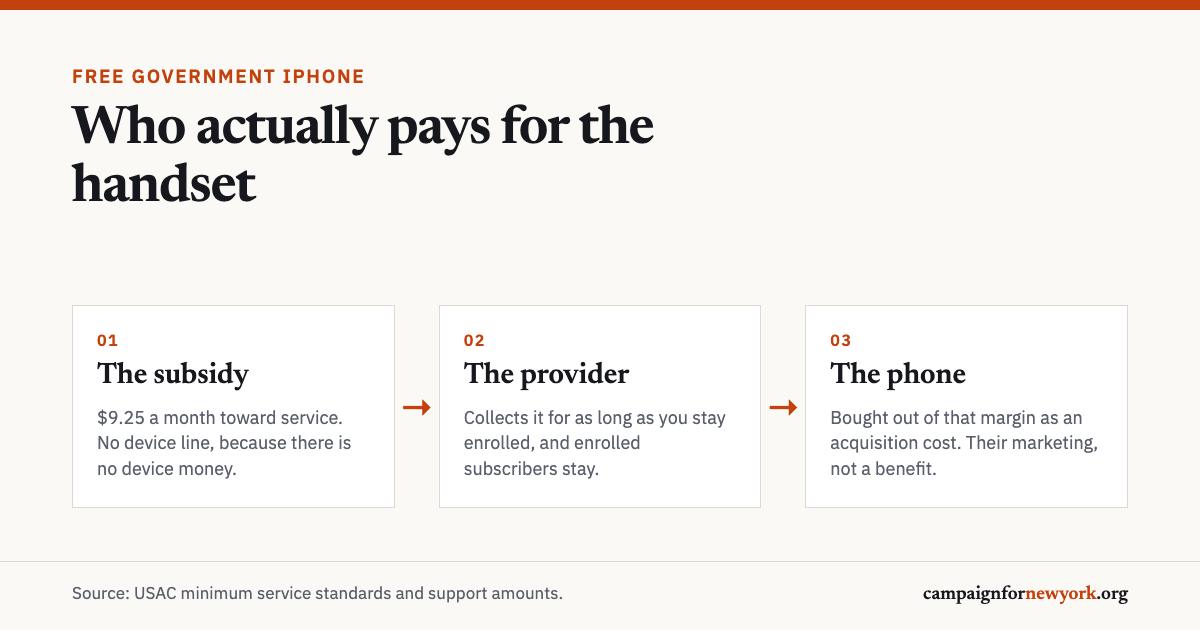
Lifeline pays for service. It has never paid for a handset. When a provider gives you a free phone — iPhone or otherwise — that phone is their marketing cost, funded out of the margin on the subsidy they collect for keeping you as a subscriber. That is legal and it is normal. It is not the government giving you an iPhone.
Does the government give out free iPhones in New York?
No. Neither the FCC, nor USAC, nor New York State buys anybody a phone. What the federal programme does is pay a fixed amount toward a monthly bill — $9.25 for broadband, $5.25 for voice-only. Look at USAC’s own support table and every line is a service. There is no device line, because there is no device money.
Even the companies selling these phones say so when you read closely enough. One provider blog ranking near the top for this exact query opens its answer with the sentence that the State government does not hand out iPhones directly — and then spends two thousand words on the phones it will send you.
So where does the free phone come from?
From the provider, as a cost of getting you. A Lifeline subscriber is worth roughly $9.25 a month to the provider for as long as they stay enrolled, and enrolled subscribers tend to stay. Against that, sending out a handset is an acquisition cost like any other, the same logic as a free phone on a two-year contract.
That changes what questions are worth asking. You are not asking a government office for a benefit. You are accepting a commercial offer from a company that wants your subscription, and the normal rules for reading a commercial offer apply.
Was there ever federal money for a device?
Yes, and it is gone. This is where a lot of stale advice comes from. The Affordable Connectivity Program paid up to $30 a month toward broadband, up to $75 on Tribal lands, and a one-time device discount of up to $100 toward a laptop, desktop or tablet through a participating provider.
The ACP ended on 1 June 2024 for lack of funding from Congress. USAC says so plainly on its own ACP page.
That $100 was the only federal device money there has ever been in this space, it was never enough for an iPhone, and it has been over for more than two years. Any page still offering you a free tablet through ACP is describing something that does not exist.
Which providers can actually give you a phone in New York?
USAC publishes the live list as open data, and it is a much better source than anybody’s marketing page. Filtered to New York, six mobile providers cover all sixty-two counties: Assurance Wireless, SafeLink, TruConnect, Access Wireless, AirTalk Wireless and Gen Mobile. Their customer service numbers are below:
| Provider | New York counties covered | Customer service |
|---|---|---|
| Assurance Wireless | 62 of 62 | 888-321-5880 |
| SafeLink / Straight Talk / Total Wireless | 62 of 62 | 833-333-9227 |
| TruConnect | 62 of 62 | 800-430-0443 |
| Access Wireless | 62 of 62 | 866-594-3644 |
| AirTalk Wireless | 62 of 62 | 855-924-7825 |
| Gen Mobile | 62 of 62 | 833-528-1380 |
Two things about that table are worth saying out loud.
First, I went in expecting the heavily-advertised names to be missing, and I was wrong about AirTalk — it is a genuine New York provider covering every county. Checking beats assuming.
Second, some brands that rank very well for New York searches do not appear in USAC’s New York data at all. That is not automatically a red flag, because resellers routinely operate under a partner’s designation. Cintex Wireless is the clearest case: its own site says its service is powered by AirVoice Wireless, and USAC’s New York list contains neither name. So if a site is selling you a New York plan under a brand USAC does not list here, ask which carrier’s designation you are actually being enrolled under before you hand over anything.
How do you check whether an offer is real?
Four checks, and they take about five minutes. Check the provider against USAC, not against the advert. The Companies Near Me tool takes your ZIP and returns the companies USAC has on file for it.
Check the ZIP in their own screenshots. This sounds petty and it is remarkably revealing. One page ranking above this one for a New York query illustrates its New York advice with a plan screenshot for ZIP code 07008. That is Carteret, New Jersey. Nobody checked.
Check whether they want to take your application by phone. They cannot. USAC’s instructions to providers say plainly that a provider cannot accept a Lifeline application over the phone and cannot initial or sign it on your behalf. If someone offers to do exactly that, hang up.
Check what happens to the phone if you leave. Ask directly whether the device is yours outright, whether it is locked, and what the terms are if you switch providers or lose eligibility. Get the answer before you accept, not after.
What device should you realistically expect?
Model availability moves constantly and depends on your ZIP code and whatever stock the provider is holding that week, which is exactly why this page does not print a list of models. Any specific handset named on a page like this one is out of date within weeks. If a site tells you confidently which iPhone you will receive, that is a sales page, not information.
What is stable is the shape of the offer. Higher-value handsets tend to come with a co-payment or an upgrade fee rather than being free outright, stock varies by area, and applying earlier gives you more choice than applying later. Ask the provider what is actually in stock for your ZIP today, and ask what it costs.
What plan comes attached to the phone?
The handset is the advertisement. The plan is the thing you actually live with, and it is the part worth reading. USAC sets minimum service standards a plan has to meet before the provider can claim reimbursement for it. For mobile that is 1,000 minutes of voice, and for mobile broadband, 3G speed or better with a 4.5 GB monthly allowance.
4.5 GB is the number to hold on to, because “unlimited” on a Lifeline plan almost never means unlimited at full speed. It means a high-speed allowance followed by throttling, and the throttled speed on some of these plans will not carry video at all.
Ask two questions before you accept anything. How much high-speed data, in gigabytes? And what speed does it drop to afterwards? A provider that will not answer the second one in a number has told you something.
What are the warning signs of a fake offer?
The genuine providers are boring. The problems come from sites that sit between you and them. It wants your Social Security number on a web form before anything else. The real application is at the National Verifier or with a provider you have chosen. A comparison page or a blog has no reason to hold that.
It offers to complete the application on a phone call. Providers are not permitted to do this. USAC’s instructions say a provider cannot accept a Lifeline application by phone and cannot initial or sign it for you.
It names a specific iPhone model as guaranteed. Stock varies by ZIP and by week. Certainty here is a sales technique.
It describes ACP, a $30 credit, or a free tablet. That programme ended on 1 June 2024. A page still selling it has not been touched in over two years, whatever date sits at the top.
It will not say whose designation you are enrolling under. Every legitimate Lifeline enrolment happens under some carrier’s designation. If nobody will name it, do not proceed.
What happens to the phone at recertification?
The phone is generally yours. The service is not. Lifeline requires you to recertify once a year that you are still eligible, and missing it removes you from the programme. When that happens the subsidy stops, and what the provider does next varies — some move you to a paid plan, some suspend the line.
The handset usually stays with you, but it may be network-locked, which is why the question is worth asking at the point of accepting it rather than a year later when you want to move.
This is where most people lose the benefit — not at the application, at the renewal, because the notice went to an address or number that had changed. Set a reminder for a month before your enrolment anniversary.
Can two people in the same house each get one?
Only if they are genuinely two households, and the test is not what you might assume. Lifeline defines a household as everyone at an address who shares income and expenses. Two families under one roof with separate finances are two households, and both can hold a benefit. A couple sharing a budget are one household however many phones they own.
Where there is already a subscriber at your address, you complete a Lifeline Household Worksheet showing you are separate. That form exists specifically so that shared housing, rooming houses and multi-family homes are not shut out, and filling it in is normal rather than suspicious.
Do not be talked into claiming two benefits for one household because a salesperson suggests it. The benefit is checked against a national database, duplicates surface, and it is the subscriber who carries the consequence rather than the person who sold it.
Should you bring your own phone instead?
Often, yes — and almost nobody suggests it, because there is no margin in suggesting it. If you already have a working handset, bringing it keeps you unlocked, keeps you free to switch providers when the service turns out to be poor, and removes the main reason people stay on a plan they dislike. The service subsidy is identical either way. The $9.25 does not shrink because you declined the phone.
The case for taking the device is simple and real: you do not have a working phone, or the one you have is failing. That is a good reason. Wanting a newer iPhone than the one in your pocket is a worse one, because the phone is what keeps you tied to a provider you have not tested yet.
Is this the benefit worth chasing at all?
Probably not, if you have to pick one. A free handset is a one-off. New York’s Affordable Broadband Act is a standing obligation on large internet providers to sell qualifying households home internet at $15 a month for 25 Mbps, or $20 for 200 Mbps, with taxes and equipment inside the price. Against a typical New York broadband bill that is worth far more over a year than a refurbished handset, and it is claimed by far fewer people.
Chase the internet first. Then, if you still need a handset, take the phone.
The full detail on the $15 entitlement is in the guide to the Affordable Broadband Act. How the phone subsidy itself works, and the three New York-only ways to qualify for it, is in the Lifeline guide. If you are not sure which programmes you are already on, start with the eligibility walkthrough.