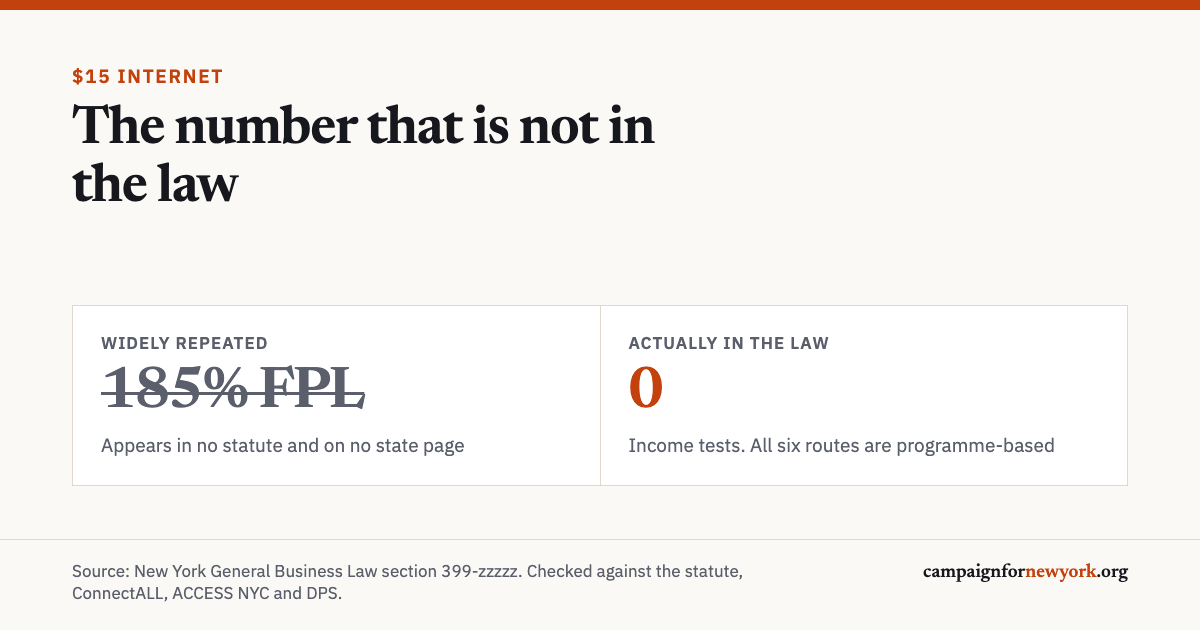
There is no income limit in the Affordable Broadband Act. The 185% of the federal poverty level figure that appears across most articles on this subject is in the statute, on the Governor’s announcement, on the Department of Public Service page, on ConnectALL and on ACCESS NYC exactly nowhere. All six qualifying routes in the law are programme-based.
Is there an income limit for the $15 internet plan?
Not in the law. New York General Business Law § 399-zzzzz qualifies a household by the programmes it receives, not by what it earns. The six routes are free or reduced-price school lunch, SNAP, Medicaid, the Senior Citizen Rent Increase Exemption, the Disability Rent Increase Exemption, and a utility affordability benefit, for which the State names HEAP. You need one of them. Your income is not asked about, because it is not the test.
That is a genuinely unusual design, and it is why the entitlement is easier to claim than most benefits: you are not proving a financial position, you are proving membership of a programme that has already done that assessment.
You can read the section at the New York Senate, and the State repeats the same list on ConnectALL and the City on ACCESS NYC.
Where did the 185% figure come from?
Honestly, I do not know, and I went looking properly before saying so. I checked the statute, the Governor’s announcement, the Department of Public Service page, ConnectALL and ACCESS NYC. The number is on none of them. What it looks like is a figure that entered one article, was copied by the next, and has been repeated since by pages that never opened a primary source.
185% of the federal poverty level is a real threshold elsewhere — it is used in several nutrition and health programmes — which is probably why it looked plausible enough to survive. Plausible is how errors travel.
The practical damage is specific rather than abstract. A household above that imaginary line, holding SNAP or Medicaid, reads the figure, decides it does not qualify, and never asks. It would have qualified. The entitlement was never income-tested.
So why do some providers ask about income?
Because a provider may offer an income route of its own, on its own terms, and that is a different thing from the statute. Optimum, for example, uses 200% of the federal poverty guideline as one of many ways into Optimum Advantage. That is Optimum’s rule. It widens their eligibility rather than narrowing yours, and it exists alongside the statutory routes rather than replacing them.
This is the distinction to hold on to whenever a provider quotes you a number: a branded product’s eligibility list and the law’s list are two documents, and the branded one is usually shorter in some places and longer in others.
The version that costs people money runs the other way. Spectrum Internet Assist accepts only school lunch, its Community Eligibility Provision, and SSI — leaving out SNAP and Medicaid, both named in the statute. What to do about that is in what to say when Spectrum refuses you on SNAP.
Which programme has an income limit, then?
Lifeline does, and mixing the two up is easy because they are usually written about together. The federal Lifeline programme qualifies a household at or below 135% of the federal poverty guidelines. Those are the current figures from USAC’s consumer eligibility page:
| Household size | Gross annual income at or below |
|---|---|
| 1 | $21,546 |
| 2 | $29,214 |
| 3 | $36,882 |
| 4 | $44,550 |
| 5 | $52,218 |
| 6 | $59,886 |
| 7 | $67,554 |
| 8 | $75,222 |
| Each additional person | add $7,668 |
So one of these two benefits is income-tested and the other is not. If you have read that the $15 internet plan uses an income threshold, what you have probably read is Lifeline’s rule wearing the wrong label — with the wrong number attached as well.
How do you check a figure like this yourself?
Ask one question of any number you are given: which document says so. A figure with no source behind it is a claim, whoever is making it. That applies to this page too, which is why every number here links to the statute or the agency rather than to another article. A competitor’s page is evidence about what the search results say. It is never evidence about what the law says.
Poverty guidelines are the specific trap, because they change every year. When I last checked the top results for one of these queries, one page was quoting the previous year’s income limit and another had a number matching no year at all. Neither linked to a source, which was the tell.
Two more things worth checking before trusting a page on this subject. Does it still describe the Affordable Connectivity Program’s $30 credit or $100 device discount as available? That programme ended on 1 June 2024. And does its screenshot show a New York ZIP code? One page ranking for a New York query illustrates its advice with a plan for ZIP 07008, which is Carteret, New Jersey.
What should you actually ask a provider?
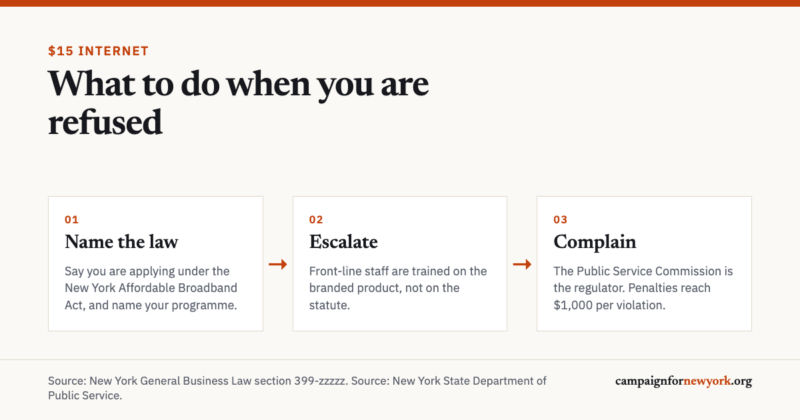
Lead with the programme, not with your income. Say you are applying under the New York Affordable Broadband Act and name the programme you receive. That is the whole of the statutory test, and volunteering income figures invites an assessment against a branded product’s rules instead.
If you are not on any of the six routes, then income becomes relevant, but only as the provider’s own optional route. Ask directly: what income limit do you use, and what proof do you want. The answer varies by company and it is theirs to set.
Where a provider quotes you a percentage of the poverty level as though it were the law, ask which programme they are describing. Most of the time the answer will be their own product, which is a perfectly legitimate thing for it to be — it just is not your entitlement.
Does the same confusion affect who has to offer the plan?
It does, and in the same direction: a real number gets swapped for an imagined one. The threshold in the statute is 20,000 households served in New York. Above it, a provider must offer the plan everywhere it operates in the state. Below it, a provider may seek an exemption where complying would cause an unreasonable or unsustainable financial impact, and the Public Service Commission has reinstated temporary exemptions for that group.
What that means in practice is that Charter, Altice and Verizon are all covered without argument, while a small upstate telephone company genuinely may not be. There is no postcode test and no rural carve-out for a large provider — the obligation follows the company, which is covered in which providers must offer the $15 plan in your county.
What is at stake if the myth puts you off?
A capped price for as long as you keep the service, which is worth more than the monthly figure suggests. Tier 1 is $15 a month for 25 Mbps or better; Tier 2 is $20 for 200 Mbps or better. Recurring taxes, equipment rental and usage fees all sit inside those prices, so no modem charge is added afterwards and there is no overage.
The increases are capped as well, and differently for each tier. A Tier 1 price may rise once every five years, a Tier 2 price once every two, and either way by no more than the lesser of the consumer price index change or 2% a year, after thirty days’ notice.
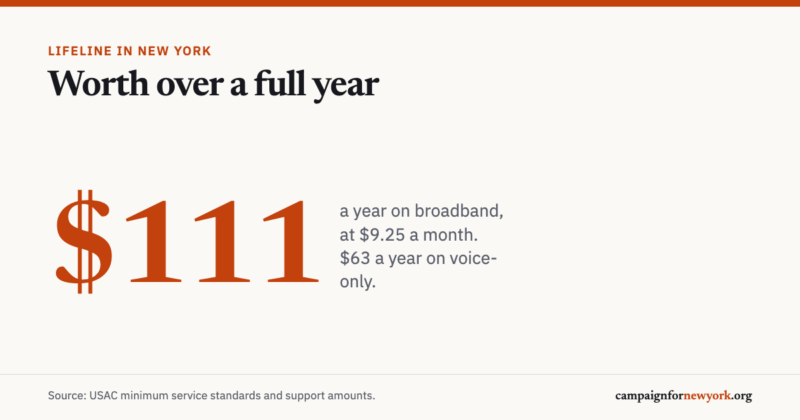
Then it stacks with the federal discount: $9.25 off, taking a $15 plan to $5.75 a month, which is covered in using Lifeline and the $15 plan together. The entitlement in full is in the Affordable Broadband Act guide, and how figures on this site are checked is set out in how we research.